Culture | Sep. 2026
PAPER TRAIL
By Bill McLean
illustration by Tom Bachtell

JWC Media
a luxury lifestyle website that delivers a colorful and passionate telling of neighboring events, fashion, beauty, finance, and the pursuit of leisure.
By Bill McLean
illustration by Tom Bachtell
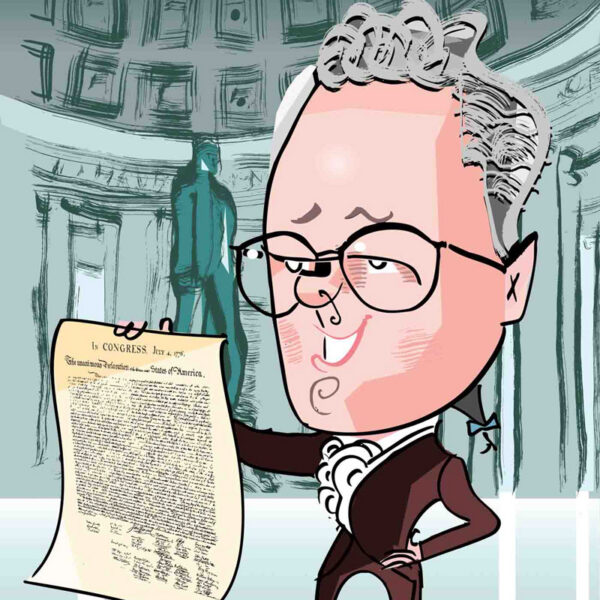
Some people collect baseball cards. Others collect art. Seth Kaller collects goosebumps. Not intentionally. They simply happen whenever somebody leans over a display case, stares at an early printing of the Declaration of Independence or the Constitution, and suddenly isn’t looking at old paper anymore. They’re looking at an idea.
“I’ve seen people with tears in their eyes,” says Kaller, a nationally recognized expert in America’s founding documents.
On October 22, Lake Forest High School audiences will have an uncommon opportunity to stand where museum visitors usually stand. Kaller will present The Promise of Liberty three times that day—twice for students and once for the public—bringing with him rare early printings of the Declaration of Independence, the Constitution, the Bill of Rights, George Washington’s first Thanksgiving Proclamation, documents connected to Abraham Lincoln, women’s suffrage, and Martin Luther King Jr.’s “I Have a Dream” speech, which gave the exhibit its name by calling the Declaration and Constitution “a promissory note.”
If Kaller sounds as though he was destined for this work, maybe that’s because he almost was. His family’s business dealt in rare stamps and coins. By fifth grade he was reading U.S. News & World Report and Newsweek for fun. At 11, he visited the National Archives and found himself fascinated by documents most kids would have walked past without slowing down.
“I’ve always been interested in history, politics, and what is going on in the world,” says Kaller, who lives in White Plains, New York.
Oh, and the last four digits of one of his phone numbers? 1776.
How spirited.
“I had to fight for those,” he says, laughing.
That sense of playfulness follows him, but so does curiosity. During a presentation to students from India in 2022, Kaller realized something unexpected. He wasn’t merely talking about history. He was talking about technology.
After all, America’s founding documents couldn’t simply be emailed, texted, posted, or livestreamed in the late 1700s. If people across the young nation were going to read them, printers had to produce and circulate copies. Those printings were the internet of their day.
“It hit me,” Kaller says. “I could talk about not just history, but technology as well.”
He uses the word to describe more than the delivery mechanism of ink on paper or vellum, but also the ideas they convey.
“Technology is more than gadgets. It is also a system of organizing knowledge to solve problems. That is precisely what the Founders created for us.”
His favorite documents aren’t merely relics. They’re conversation starters. Kaller wants visitors to leave his presentations thinking less about our differences and more about our possibilities.
“I hope people become inspired to see the possibility of government as a good thing,” he says, “as something that can be good—because that is what we need it to be.”
That’s a lofty goal.
Then again, history has always been full of ambitious ideas. Sometimes all it takes to rediscover one is standing a few inches from an old piece of paper.
For more information about Seth Kaller, visit sethkaller.com or thepromiseofliberty.org. Kaller’s full Promise of Liberty exhibition, guest curated by Ken Burns, is at the Peoria Riverfront Museum through January 3, 2027.