Culture | Apr. 2026
BOTANICAL BRIDGES
By Roni Moore Neumann
ILLUSTRATION BY ROBERT RISKO

JWC Media
a luxury lifestyle website that delivers a colorful and passionate telling of neighboring events, fashion, beauty, finance, and the pursuit of leisure.
By Roni Moore Neumann
ILLUSTRATION BY ROBERT RISKO
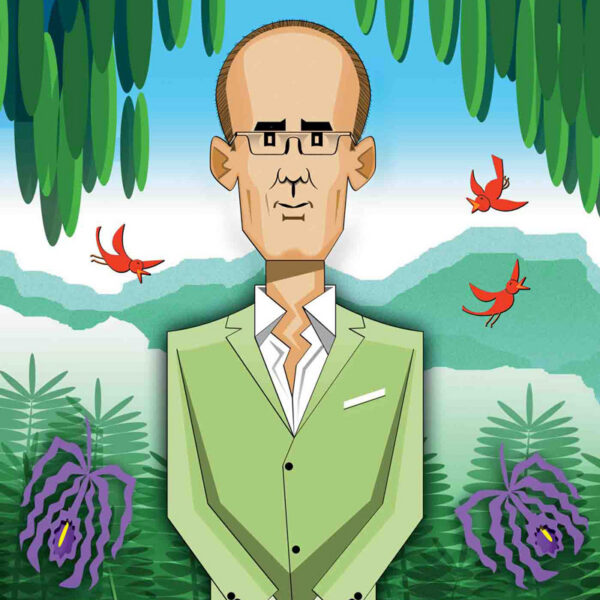
At first glance, Royal Botanic Gardens, Kew might seem an unlikely destination for a former BBC executive. But for Richard Deverell, its director since 2012, the journey feels entirely logical—a career shaped by science, storytelling, public engagement, and a deep belief in service.
Raised with a fascination for the natural world, Deverell read Natural Sciences at the University of Cambridge, where his conviction took root: science is humanity’s most powerful tool for solving the great challenges of our time.
Deverell spent a decade at BBC News, leading its websites during a sweeping digital transformation and later revitalizing its children’s channels, including science programming designed to ignite young minds. Translating complex ideas for broad audiences while modernizing legacy institutions became the hallmarks of his leadership.
Those skills proved unexpectedly transferable to Kew, the world’s largest botanic garden, one of its most storied scientific institutions, and a UNESCO World Heritage Site. Under Deverell’s stewardship, Kew has strengthened its global scientific research, expanded its conservation impact, and deepened visitor engagement, all while reinforcing long-term financial sustainability.
“I’m passionate about the power of plants and fungi to help solve the critical challenges facing humanity in the 21st century,” he explains. From climate resilience to food security and human health, plants are not merely a backdrop but the backbone. “After all, all life depends on plants.”
His contributions to public understanding of science have earned significant recognition, including an honorary doctorate from Royal Holloway, University of London and a CBE for services to botany and conservation. In 2025, he was appointed to the UK Soft Power Council, underscoring the increasingly diplomatic role institutions, including Kew, play in fostering international collaboration.
That global perspective was featured in Chicago this fall at the Kew Symposium, “Big Challenges and Big Solutions: Global Biodiversity and Resilience.” Hosted in partnership with two of the Midwest’s leading institutions, the Chicago Botanic Garden and The Morton Arboretum, the gathering highlighted the urgency of biodiversity loss and the interconnectedness of environmental and human health. The symposium underscored that biodiversity loss is directly linked to climate resilience, food security, urban health, and economic stability.
Among the calls to action: dramatically scaling up global plant conservation; investing in nature-based urban infrastructure to mitigate flooding and improve air quality; protecting keystone species such as oaks through international seed banking and research; and adopting innovative conservation techniques adapted from zoology to safeguard critically endangered plants.
Above all, Deverell emphasizes a shift from isolated excellence to networked impact by sharing data, collections, and expertise across borders. “Plants may be rooted in place,” he says, “but protecting them has to be a global endeavor.”
Chicago has become a particularly meaningful partner in that regard. Members of The Morton Arboretum collaborated with Kew to create the American Prairie at Wakehurst, introducing a 6-acre slice of North American ecology into the British landscape. Kew Foundation America, headquartered in Chicago, played a major philanthropic role in the renovation of Kew’s historic arboretum. Even Kew’s own Children’s Garden drew inspiration from the pioneering Children’s Garden at Morton.
There are personal ties as well. One of Deverell’s predecessors, Sir Peter Crane, led the Field Museum in Chicago, further strengthening the botanical and scientific bridges between the cities.
For Deverell, these partnerships are not symbolic—they are essential. Kew works with approximately 120 organizations worldwide, and every major scientific or conservation initiative is collaborative. In an era of climate volatility and ecological strain, no institution can operate in isolation.
Looking ahead, Kew faces projects as ambitious as its mission. The iconic Palm House, one of the world’s most important Victorian glasshouses, is preparing for a once-in-a-generation renovation to safeguard its irreplaceable tropical plant collections for decades to come. Fundraising is underway before the structure closes for extensive restoration. Meanwhile, The Waterlily House renovation, supported by a £5 million gift from The Julia Rausing Trust, begins this spring. These renovations will allow both The Palm House and The Waterlily House to become the world’s first ever net-zero glasshouses, storing more carbon than they release by 2030.
Despite the scale of these undertakings, Deverell remains grounded in simple advice, especially for young people considering unconventional careers. Stay curious. Ask questions. Don’t expect a linear path. Take risks. Show initiative. Treat people well—they will always remember it.
And perhaps most importantly: spend time in nature. “It always helps me to reflect and clear my thoughts,” he observes, echoing what science has increasingly confirmed: time outdoors is medicine.
In Deverell’s world, the arc from Cambridge lecture halls to BBC studios to Victorian glasshouses is not a departure from science, but an expansion of it. Storytelling and botany, diplomacy and conservation, Chicago and London—all converge in a singular mission: connecting people with plants, and in doing so, safeguarding our collective future.