Features | Nov. 2026
THE WORK OF HOME
By Monica Kass Rogers
Lori Sugarman-Li. Photography by Devin Doyle

JWC Media
a luxury lifestyle website that delivers a colorful and passionate telling of neighboring events, fashion, beauty, finance, and the pursuit of leisure.
By Monica Kass Rogers
Lori Sugarman-Li. Photography by Devin Doyle


Despite good intentions, when two people come together to share a living space, one important topic almost always gets overlooked: how they will approach the many hours of unpaid domestic labor required to make their house a home. Who’s doing what? How do they share the load? And what unspoken expectations do they have without even realizing they’re there?
“When a couple comes together, the big conversations are usually about whether or not to have children, or how to practice religion,” says Lori Sugarman-Li, certified Fair Play facilitator, family coach, author, and founder of Our Home Our Pride. “Very rarely are the conversations about how they want home systems to operate. Nobody is saying, ‘Hey, how do you deal with garbage? When do you like the dishes to be done, or the sheets to be changed?’”
Such topics may seem insignificant at first glance, but they are linked to much deeper societal norms that, if unchallenged, can eventually create imbalance and resentment around tasks in the home.
“The smallest fights about laundry and dirty dishes are actually linked to systemic issues affecting millions of families across the globe,” says Sugarman-Li. “There are societal definitions of what we believe men versus women are capable of, such as the myth that women are better at caring and nurturing than men. Or the way we gender tasks, assigning ‘daily grind’ work such as school mornings to women—getting everyone dressed, fed, and out the door—while less-frequent tasks that happen outside the home, such as mowing the lawn and getting the oil changed, are considered men’s work.”
And then there are the toxic messages that say paid work is more important than unpaid work, or that women should be in service from dawn until dusk to have value.
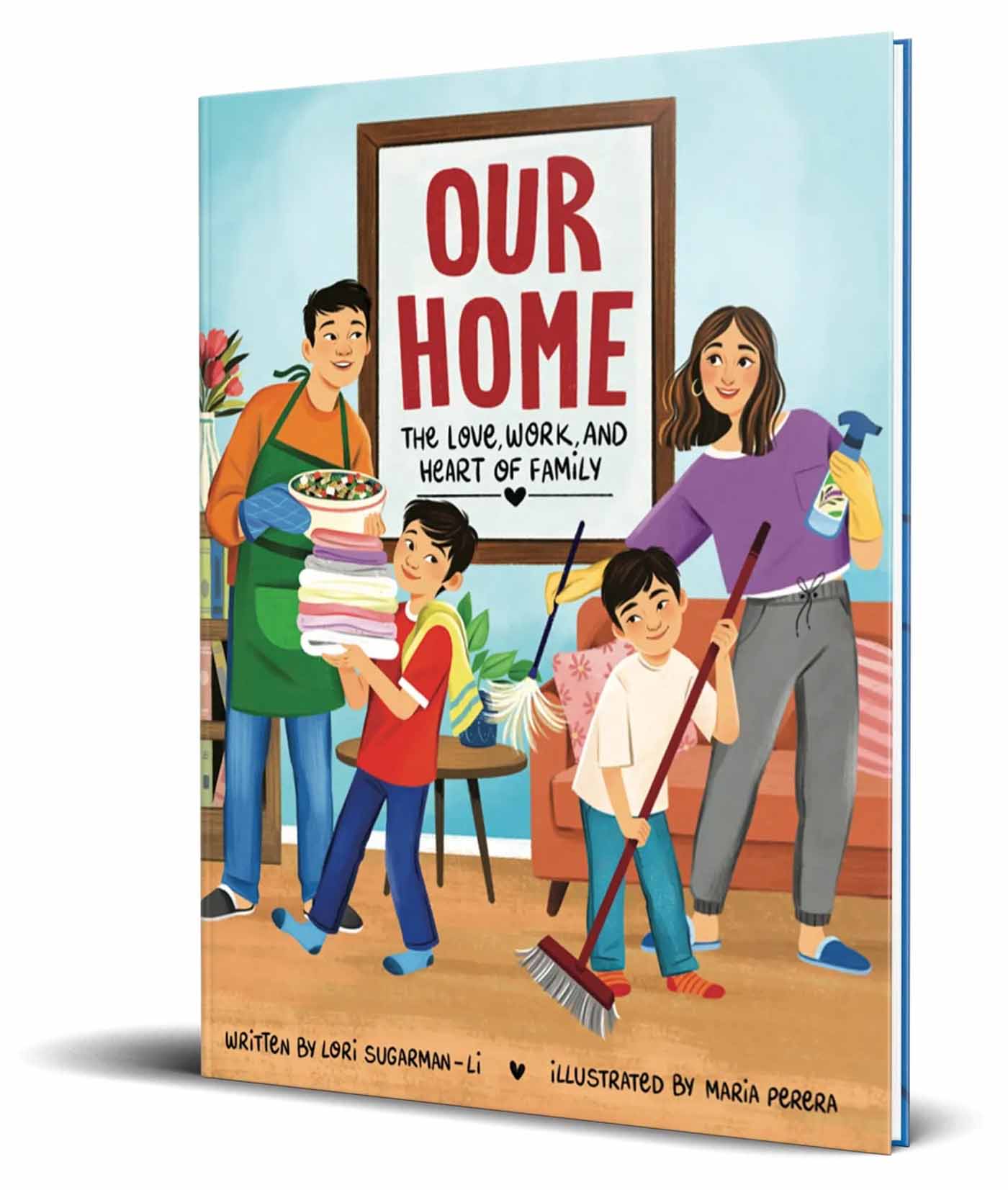
These are the kinds of topics Sugarman-Li helps families navigate as they work to build peaceful, better-balanced homes. She launched her coaching practice and wrote an award-winning children’s book, Our Home: The Love, Work, and Heart of Family, to help guide the way.
“I call myself ‘WD-40 for families,’” she says, “teaching the language, the systems, and the boundaries that help families get unstuck from the weight of the domestic load.”
The process requires a lot of unlearning and relearning.
“Many couples who come to me have been doing things the way that their families did when they were children, without ever questioning why or considering which routines to keep and which to let go. It can be very freeing for them to realize they can choose to do things differently. There is so much that we can deconstruct and ultimately unlearn, so that we can relearn a better way.”
Topping Sugarman-Li’s relearning list:
A critical step in starting couples’ conversations about the work of the home is to unveil the “invisible labor” that one partner may not even realize the other is carrying.
“This is so important because what’s visible is valued and what isn’t, unfortunately, is not,” says Sugarman-Li. “And so much of the work of home and care is invisible. It’s done in what we call the ‘second shift’—early mornings, late at night, or when the rest of the family is away from home or asleep.”
To lay out the scope of this work, Sugarman-Li uses a set of cards connected to the book Fair Play by Eve Rodsky. Each card in the deck represents a domestic task.
“It’s such an ‘aha’ moment when a couple sees all these cards out on the table and recognizes just how much is done daily to support the flow and wellness of a family,” she says.
The other big “aha” is acknowledging how labor is divided.
“Research tells us that 75 percent of the unpaid labor of the home is done by women,” she says.
And while men may step up to help address this inequity, “sharing” tasks is not the best solution.
“Dividing up tasks, a.k.a. ‘sharing,’ actually makes more work for everybody,” says Sugarman-Li, “because you end up with all of this checking in: Did you do it? Did you forget? Do I have to remind? Do I have to nag?”
She says this scenario—where women are the owners of the home, and men are sort of waiting in the wings to help—is what creates a lot of the buildup of resentment in the couples she sees.
Her better solution is to give complete ownership of a task to one person: from conception to planning to execution.
“It’s how we handle our sons’ soccer,” she says. “My husband ‘owns’ that task completely. So, anything to do with soccer, I release to him. All I have to do is show up and cheer, and it’s fabulous because there’s no second-guessing. Nothing is missed, nothing is forgotten, nothing is duplicated.”
At the same time, she is quick to clarify that reducing the overwhelm of women is not achieved by overwhelming men: “The goal with complete task ownership is to create efficiency, better communication, alignment in family values, and to reduce stress.”
Sugarman-Li also sees the work of home as an important part of raising children. Household tasks, she says, aren’t simply chores to be endured or a way for parents to offload work; they’re part of a child’s education and preparation for independence.
“I love to call them an ‘expression of gratitude,’ instead of a ‘chore,’” she says.
To help with this reframing, she encourages parents to explain the “why” behind a task rather than presenting it as another item on a to-do list. Changing the sheets, for example, becomes more meaningful when a child understands that sleeping on a clean pillowcase can benefit their skin.
The goal is to help children see that caring for a home ultimately benefits everyone who lives there.
To achieve this, parents may have to let go of their own perfectionism along the way.
“It’s definitely a muscle to build,” says Sugarman-Li, “letting go in order to let them learn. Some imperfectly folded shirts or some missed spots on the counter are worth it.”
Through it all, she says, the most important thing is that unpaid tasks in the home—domestic or care work—are valued by each member of the family, because this truly is the work that makes all other work possible.
For more information, visit ourhomeourpride.com.