Features | Nov. 2026
MATCHMAKER OF MASTERPIECES
By Monica Kass Rogers
PHOTOGRAPHY BY KATRINA WITTKAMP
Joe Bein

JWC Media
a luxury lifestyle website that delivers a colorful and passionate telling of neighboring events, fashion, beauty, finance, and the pursuit of leisure.
By Monica Kass Rogers
PHOTOGRAPHY BY KATRINA WITTKAMP
Joe Bein
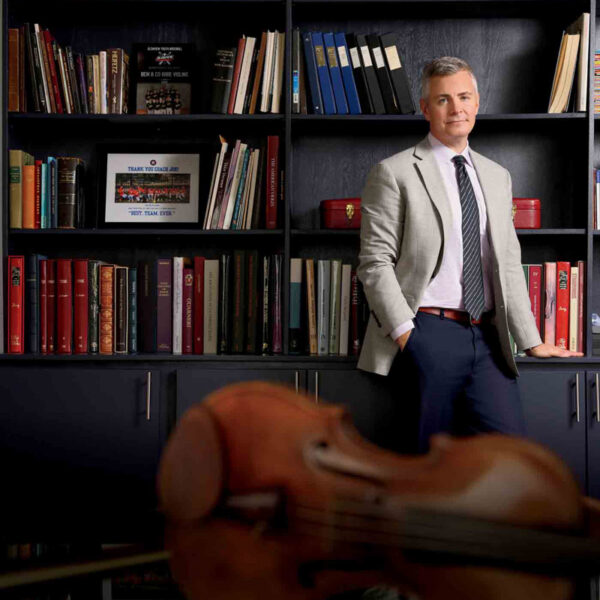
The view from the offices of Bein & Company Rare Violins on the 29th floor of Chicago’s Willoughby Tower is spectacular. Sunshine bounces off the curves of The Bean below, Gehry’s bandshell twists whimsically, miniature-looking people stroll the gardens, and toy-sized sailboats bob in the sparkling blue of Lake Michigan on the horizon.
But that view is nothing compared with the treasures displayed in Bein’s vault.
Carefully tucked into climate-controlled cubbies, about 40 of the oldest and finest stringed instruments in the world seem to glow with an inner light. A Michele Angelo Bergonzi violin made in Cremona in 1753 nestles near a Giuseppe Guarneri ‘Filius Andreae’ violin, also made in Cremona in 1720, with a Matteo Goffriller made in Venice around 1705 nearby.
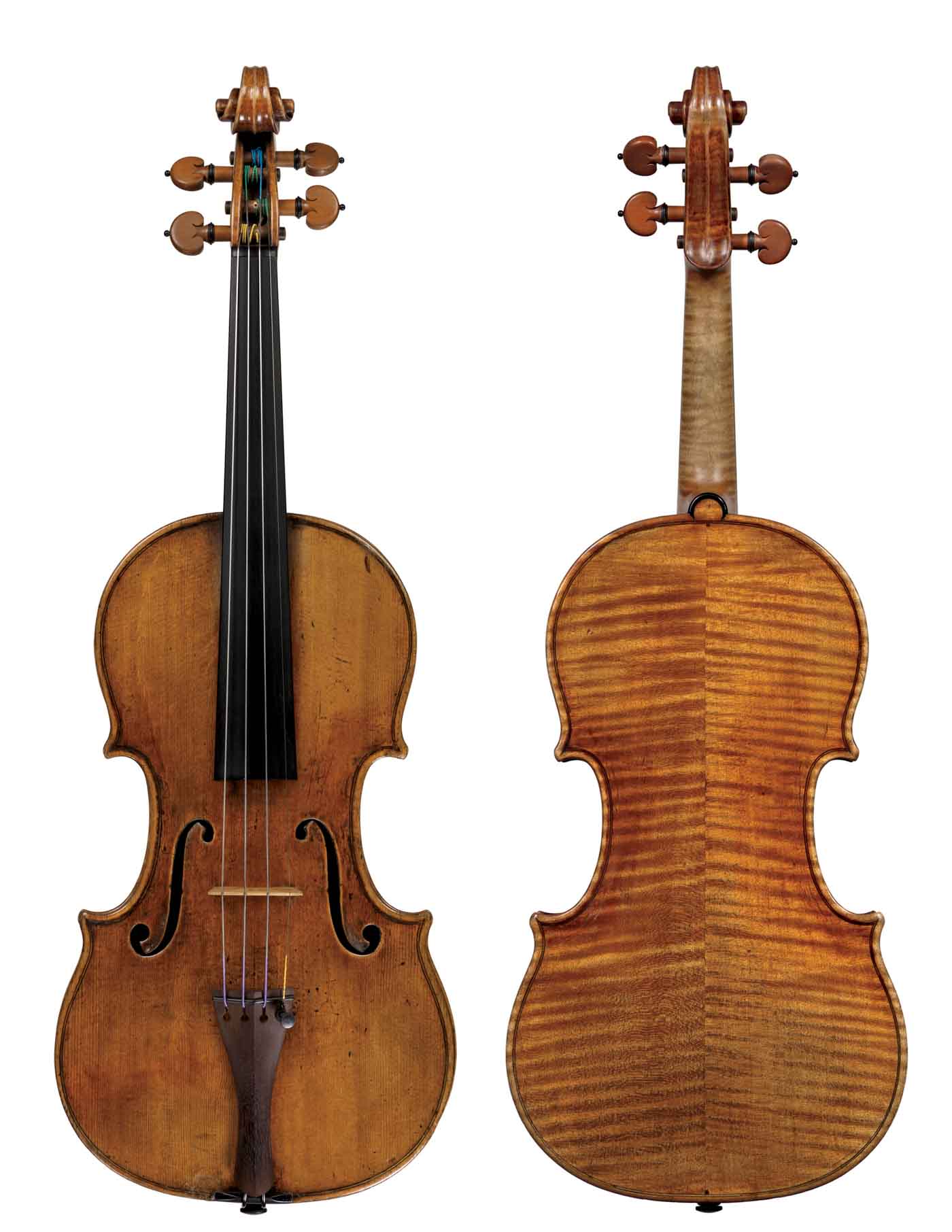
And just above these rests the 1701 ‘Dushkin,’ the perfectly preserved 325-year-old violin Antonio Stradivari made at the beginning of his Golden Period (1700–1720), now worth about $13 million.
One can’t help but imagine that when the vault clicks shut, the lights dim and the office empties, these pedigreed prodigies share stories of the hands that made them, the Medicis they serenaded, and the concert halls and palaces in which their notes once soared.
Because this scenario exists only in the imagination, it falls to Joe Bein to research and share each instrument’s story and, ultimately, find it a home, as his father did before him.
There’s a lot to know.
From construction, geometry, varnish, and condition to the where and when of an instrument’s provenance, sequence of ownership, and history, every detail must be meticulously researched.
“It’s a really critical component of our business,” says Bein, “one of the primary things my dad taught me is that there is a process and system to determining who made an instrument. Knowing the identifying characteristics, the little tells and breadcrumbs that makers leave behind as clues is crucial. You begin to know a Stradivari from a Guarneri, or a Bergonzi from an Amati and so forth.”
One helpful fact is that there wasn’t much cross-pollination between violin makers in different cities.
“Many of these places were city-states at the time— there were literal walls around them,” Bein explains. “So, the violin makers in Bologna tended to stay in Bologna, and the makers in Cremona, in Cremona. As a result, there was a school and a style created within each city that you learn to recognize if you do this for a living.”
As for individual makers, a violin’s outline is basically a maker’s fingerprint.
“Most makers have an outline that is unique to them,” says Bein. “It’s a little bit like if I pressed my hand against a window: My fingerprints would all look the same from three feet away. But when you get up close, you realize they’re completely unique.”
Retaining all this information requires a good memory, aided by a well-stocked library of reference books, photographs, and notes. And if there is any uncertainty?
“Two heads are often better than one,” says Bein.
“Working with other experts to figure out attributions can be a good thing.”
Illustrating some Stradivari “tells” Bein lifts the Dushkin violin from its berth. He turns it to show the distinct, well-preserved red varnish on the back—a back that he says also reveals Stradivari’s “mad genius” through its unusual arching.
“And see how the sound holes are perfect circles?” he asks. “This reflects the precise use of a compass in the design.”
But it’s the sound of the Stradivari that’s most wondrous.
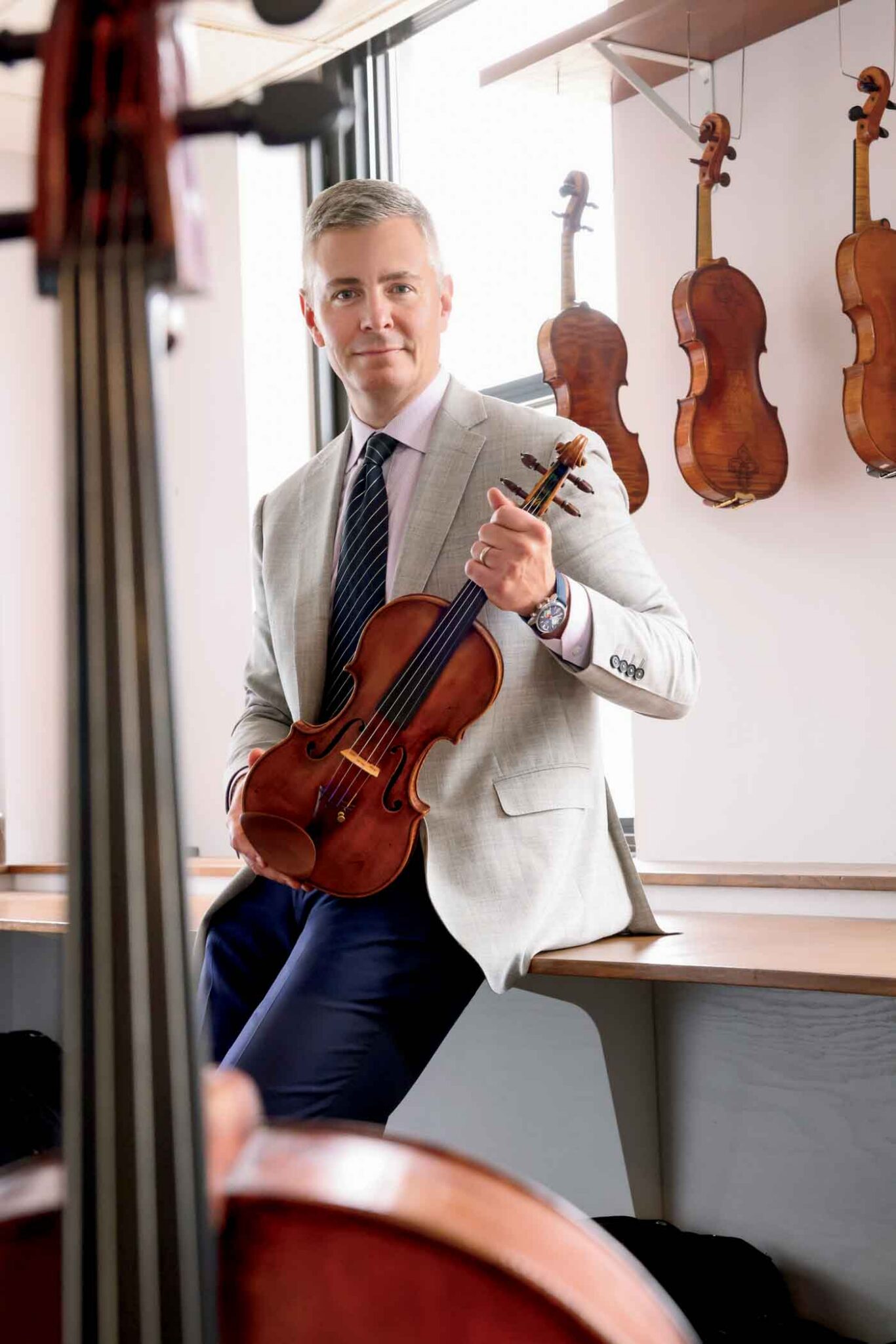
At Bein’s invitation, a top-tier violinist who has stopped in for a visit takes the violin in hand and plays a flourish of soaring notes that linger impossibly in the air. The bow he uses, also part of Bein’s collection of rarities, is fabled to have once been used by its former owner, Toscha Seidel, to accompany Judy Garland for the recording of “Over the Rainbow” in the original Wizard of Oz.
“Magical, yes?” Bein says, smiling.
“We sometimes describe the relationship between a bow and a player as ‘the wand choosing the wizard,’” he confides. “Even if a musician has owned a violin for decades, switching to just the right bow can reveal a new voice in that instrument.”
But knowing the world’s great violin makers and their instruments is only part of Bein’s business. He also needs to know who owns these rarities now—and which violinists and institutions are looking to buy them.
Because there are so few of these instruments left, they command ever-increasing sums.
The recent $23 million sale of a Stradivari violin from collector David Fulton’s holdings set a world record for the highest price paid for a violin, according to The Strad, which also reported that Joe Bein found the buyer.
“The availability of these instruments is very limited, so playing matchmaker to place them is a really fun part of my business,” says Bein. “I have 25 years of my own experience and half a century of my family’s relationships to build on. It’s up to me to know where the proverbial secrets are—where these rare instruments are located and to have direct lines to the owners.”
Descended from a paternal line of musicians, Bein’s expertise has precedent.
His grandfather attended the Eastman School of Music in Rochester, New York, married a professional violinist, and served as the viola professor at Miami University in Ohio for 50 years. Then Robert, Bein’s dad, was a cellist who studied for a time at the prestigious Mannes School of Music in New York City before a specific cello bow got him into the world of rare stringed-instrument dealing.
“It’s actually quite a story,” says Bein.
Dad had just received a modest inheritance from his grandmother and set off to a violin shop in Cincinnati to find a new cello bow. He hoped to spend about $400. The shop owner handed him a beautiful bow made by one of the two greatest bow makers of all time. Its cost was the sum of Dad’s entire inheritance—roughly $2,000.
“But playing with it was like being hit by a thunderbolt. Dad was just blown away by the fact that people had made bows like this. So, he came back a few days later and said, ‘I’ll buy the bow if you agree to give me a job.’”
Robert not only got the job, but he also soon bought the business, eventually moving to Chicago to found rare violin dealership Bein & Fushi in 1976 with partner, Geoff Fushi. He worked there until his passing in 2007.
A generous host, Robert filled the family home on Sheridan Road in Wilmette with music and famous musicians. Bein began learning the business from his dad in his teens and founded Bein & Company in 2020.
Carrying it on, Bein says, “I want myself and this business to be synonymous with, ‘If you want something really nice, that’s where you go. Joe will find it for you.’”
While the increasing rarity of the instruments he deals in is a business concern, his love for what he does keeps him going.
“Someday it will be impossible to find an Amati viola. That’s something my father’s generation never had to deal with. But like most of the people I know in music, we keep doing what we do because it’s the thing that makes our heart feel whole. That’s certainly the truth for me.”
For more information, visit beinandcompany.com.