BUILT TO LAST
By Ann Marie Scheidler
photography by James Gustin
hair by Steven Papageorge Salon
makeup by Margareta Komlenac
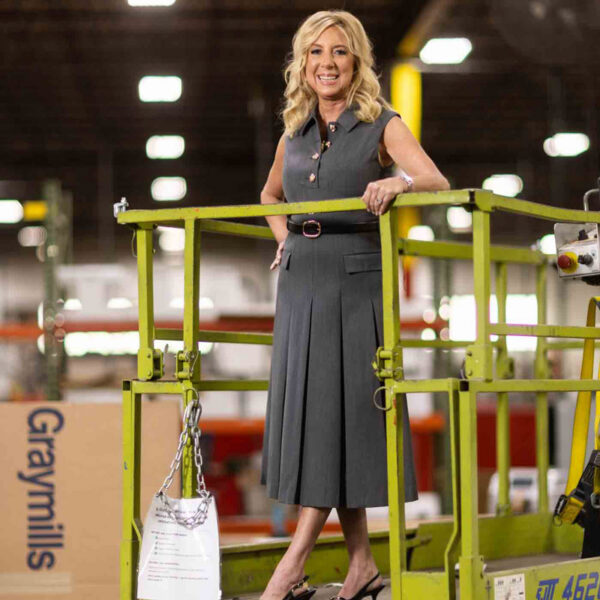
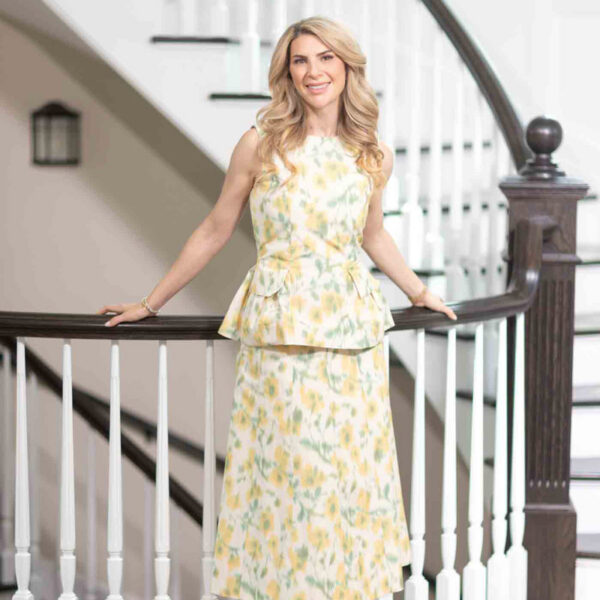
Kristen Shields wears a Grey Pleated Midi Dress from Lillie Alexander Boutique in Lake Forest.
By Ann Marie Scheidler
photography by James Gustin
hair by Steven Papageorge Salon
makeup by Margareta Komlenac
Kristen Shields wears a Grey Pleated Midi Dress from Lillie Alexander Boutique in Lake Forest.
FOR GRAYMILLS PRESIDENT Kristen Shields, manufacturing has never simply been a business. It has been an inheritance, an education, and over time, a calling.
The Broadview-based company, founded in 1939, became part of her family’s story in 1980, when her father acquired it from its second owner.
“My family is the third owner of the company,” says Shields, a Lake Forest native. “My father had the opportunity to purchase the business, and back when interest rates were like 20 percent, he did.”
Today, Graymills remains family-owned, with Shields at the helm and her younger brother, Craig Shields, serving as CEO. Together, they lead a company that manufactures pumps, parts washers, and equipment essential to industries including printing, packaging, and metalworking.
For Shields, however, this was not a career she had once imagined for herself. After college, she joined the business out of practicality more than passion.
“It was temporary,” she says with a laugh. “I needed a job. I didn’t want to live at home. I needed to make money so I could go downtown and live that life.”
But what began as a stopgap became something far more enduring.
Though she had spent summers around the business in its former Wrigleyville location, filing customer records in the paper-heavy days before digital systems, stepping into the company full time was different.
“I had been around it most of my life,” she says. “But I had never really worked in it.”
A pivotal moment came early in her career at a trade show in Germany, where she saw the first Indigo digital press unveiled to an audience of skeptics. Many dismissed it outright. Shields did not.
“A lot of people walked out saying, ‘This is never going to work,’” she recalls. “And now look. What was a brand-new idea in the 90s is now the industry standard.”
That ability to recognize change—and adapt to it—has defined much of her professional life. Over the past three decades, the printing and packaging world has undergone a profound transformation. Digital technology has not only altered the mechanics of production; it has democratized branding itself, allowing smaller companies and entrepreneurial brands to access sophisticated packaging once reserved for much larger players.
“What the digital side has done is help all of these entrepreneurs and very small niche brands have specialty packaging without the expense of long runs,” Shields says. “Now it’s hard to tell who’s the small guy versus the big guy.”
Graymills has evolved right along with the industry, expanding and changing where needed while remaining rooted in engineering and problem-solving. “Everything at Graymills starts with a pump,” Shields says—a deceptively simple statement that speaks to the company’s quiet but essential role behind the scenes.
Yet if Shields is fluent in machinery, systems, and manufacturing strategy, she is just as animated when she talks about people.
“It’s the people and the community that has kept me going all of these years,” she says. “People never really leave this industry. They may change jobs, but they don’t leave the industry.”
That loyalty is mirrored within Graymills itself. The company has long-tenured employees, second-generation workers, and families whose ties to the business stretch across decades. Shields speaks with particular affection about employees who have grown up within the company, matured alongside it, and helped carry its institutional knowledge forward.


It is also why workforce development has become one of her deepest commitments. If her generation often learned by observation and endurance, she is determined to make the path more navigable for those coming next—especially women.
“There was no such thing as mentorship” when she was starting out, Shields says. “You kind of learned as you observed.”
As a young woman in a male-dominated field, she remembers walking into meetings and plants where she was not immediately taken seriously. One piece of advice from an industry leader stayed with her: “You get five minutes on your name, kid, and after that you have to prove yourself.”
She has carried that lesson ever since.
Now nationally recognized as a mentor and advocate, Shields has become a leading voice for women in manufacturing and printing. She was one of the founding members of Women of Flexo in 2019, a group that began modestly and quickly grew into a thriving professional network with its own conference. In March, Shields delivered the keynote address at their conference in front of 200 guests titled “From Jerry’s Daughter to Industry Voice,” something she considers a career highlight. She also serves on the board of the Tag and Label Manufacturers Institute (TLMI), where she co-chairs workforce development initiatives and works on issues ranging from apprenticeships to the future of skilled labor. Last year, Shields received the TLMI Supplier of the Year Award.
“Workforce development is my passion,” she says. “How do we help people understand that manufacturing offers strong, rewarding careers? How do we create sensible pathways into these jobs?”
That question feels especially urgent now, as companies across the country struggle to recruit skilled workers while navigating technological change, sustainability concerns, and a rapidly shifting regulatory landscape. Shields is closely involved in those conversations, including upcoming meetings in Washington focused on packaging legislation and extended producer responsibility.
Still, for all the complexity of modern manufacturing, what remains most striking about Shields is the clarity with which she understands her place in it. She knows the value of experience. She knows the importance of showing up prepared. And she knows that leadership, particularly in a family business, is rarely glamorous. On any given day, the work may involve strategy, advocacy, trade associations—or something as mundane as troubleshooting operations and keeping things moving.
Asked what has kept her engaged for so many years, Shields does not hesitate. “It’s still evolving,” she says. “What I started doing 30 years ago is not what I’m doing today.”
That openness to change may be the very quality that has made her so effective—not only as a business leader, but as a steward of legacy. In Graymills, Shields inherited a company. In the years since, she has helped shape a future for it—one built not only on manufacturing expertise, but on curiosity, resilience, and a genuine commitment to the people coming next.
Sign Up for the JWC Media Email