Culture | Oct. 2026
BEAR NECESSITIES
By Bill McLean
ILLUSTRATION BY BARRY BLITT

JWC Media
a luxury lifestyle website that delivers a colorful and passionate telling of neighboring events, fashion, beauty, finance, and the pursuit of leisure.
By Bill McLean
ILLUSTRATION BY BARRY BLITT
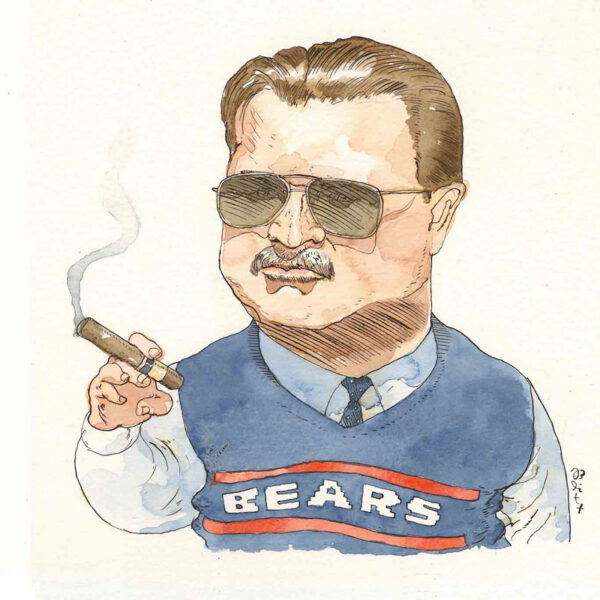
Mike Ditka looked like a Bear. Not merely a Chicago Bear. An actual bear.
The square jaw. The thick mustache. The furrowed brow. The expression suggesting that somebody, somewhere, had just committed an unforgivable football mistake.
Ursine.
That’s the word for it.
Add the aviator sunglasses, the Bears sweater vest, and a cigar clenched between his teeth, and you had one of the most recognizable figures in Chicago sports history, paws down.
You also had a man who needed no introduction. Or, occasionally, a microphone.
Ditka, who died October 9 at 86, was a Hall of Fame tight end, a Super Bowl-winning coach, and a larger-than-life personality who came to embody the toughness of Chicago, the City of Broad Shoulders. He could be gruff, generous, stubborn, charming, and infuriating. Sometimes in the same afternoon.
But nobody ever accused him of being dull.
And few sports figures ever became so thoroughly identified with a city they weren’t born in.
Ditka grew up in Aliquippa, Pennsylvania, a steel town outside Pittsburgh. His father worked for a railroad. In Aliquippa, toughness wasn’t taught. It was lived.
He carried that attitude to the University of Pittsburgh, then to the Bears, who drafted him in 1961.
The tight end didn’t merely catch passes. He punished defenders and helped the Bears win the 1963 NFL championship.
In 1988, he became the first tight end inducted into the Pro Football Hall of Fame.
But Chicago’s love affair with Ditka reached another level when he returned to coach the Bears in 1982.
He had written George Halas, the franchise’s founder, expressing his desire to lead the team. Halas eventually obliged.
What followed was football, theater, and occasional mayhem.
Ditka demanded toughness, accountability, and effort. He wanted players with blue-collar attitudes. Grabowskis, he called them. Guys who would work, sweat, sacrifice, and never complain about getting their uniforms dirty.
His teams reflected that personality. Especially the 1985 Bears.
Walter Payton. Jim McMahon. Mike Singletary. Richard Dent. William Perry.
Characters, everyone.
And Da Coach presiding over the proceedings.
The Bears went 15-1 during the regular season, steamrolled through the playoffs, and demolished New England 46-10 in Super Bowl XX on January 26, 1986.
Chicago celebrated. And kept celebrating.
The championship cemented Ditka’s standing as a civic treasure. His scowls became familiar, almost endearing. His outbursts became pure entertainment. His bluntness, whether refreshing or excessive, became part of his appeal.
He wasn’t always easy to like. Especially if you happened to be a sportswriter on the receiving end of one of his tirades. But he was impossible to ignore.
Former Chicago Tribune Bears beat writer Don Pierson, a longtime Lake Forest resident, knew that side of Ditka. Pierson covered the legendary 1985 team and met with the coach at 6 a.m. while helping him write his autobiography.
The meetings took place at Halas Hall, the Bears’ headquarters.
Pierson, honored as a Local Legend by the History Center of Lake Forest-Lake Bluff in 2023, recalled Ditka’s concentration during those sessions.
He also remembered something else.
Having covered the famously combustible Woody Hayes at Ohio State, Pierson wasn’t intimidated by Ditka.
Imagine that pairing: an unflappable reporter and a coach who sometimes treated questions like cheap shots.
Yet there was another Ditka, one whose generosity seldom generated the attention his sideline explosions did.
He supported Misericordia Heart of Mercy, the Chicago organization serving people with intellectual and developmental disabilities. His involvement went beyond financial contributions. He knew residents by name, and the organization honored him with Ditka Hall.
He also supported programs assisting former football players facing medical and financial difficulties.
The public saw the cigar-chomping tough guy. Others experienced a compassionate man.
That contrast helps explain Ditka’s enduring appeal. He wasn’t a carefully manufactured personality. He was a bundle of contradictions, capable of considerable warmth and considerable wrath.
Fans embraced him anyway.
Maybe because of those contrasts.
Maybe because he seemed to say what he meant, even when discretion would have served him better. And maybe because Chicago recognized something familiar in the man from Pennsylvania.
He liked golf, too, and belonged to Bob-O-Link Golf Club in Highland Park.
On the North Shore, his presence extended well beyond the football offices in Lake Forest.
His celebrity eventually stretched from television commercials to Saturday Night Live, where the exaggerated devotion of the Superfans turned Da Coach into a pop-culture phenomenon.
The caricature was outrageous. The affection was genuine.
Ditka spent 11 seasons coaching the Bears, leaving in 1992. No Bears coach since has delivered another Super Bowl championship.
But championships alone don’t explain why a city remembers a man decades later.
Personality does.
So does loyalty. And generosity. And the ability to make people feel something, whether admiration, frustration, or unbridled joy.
Mike Ditka gave Chicago all of it.
He arrived as a football player from Pennsylvania. He left as something unmistakably Chicago.
A Bear. In every sense of the word.